Updated October 26, 2023

Securitization Act
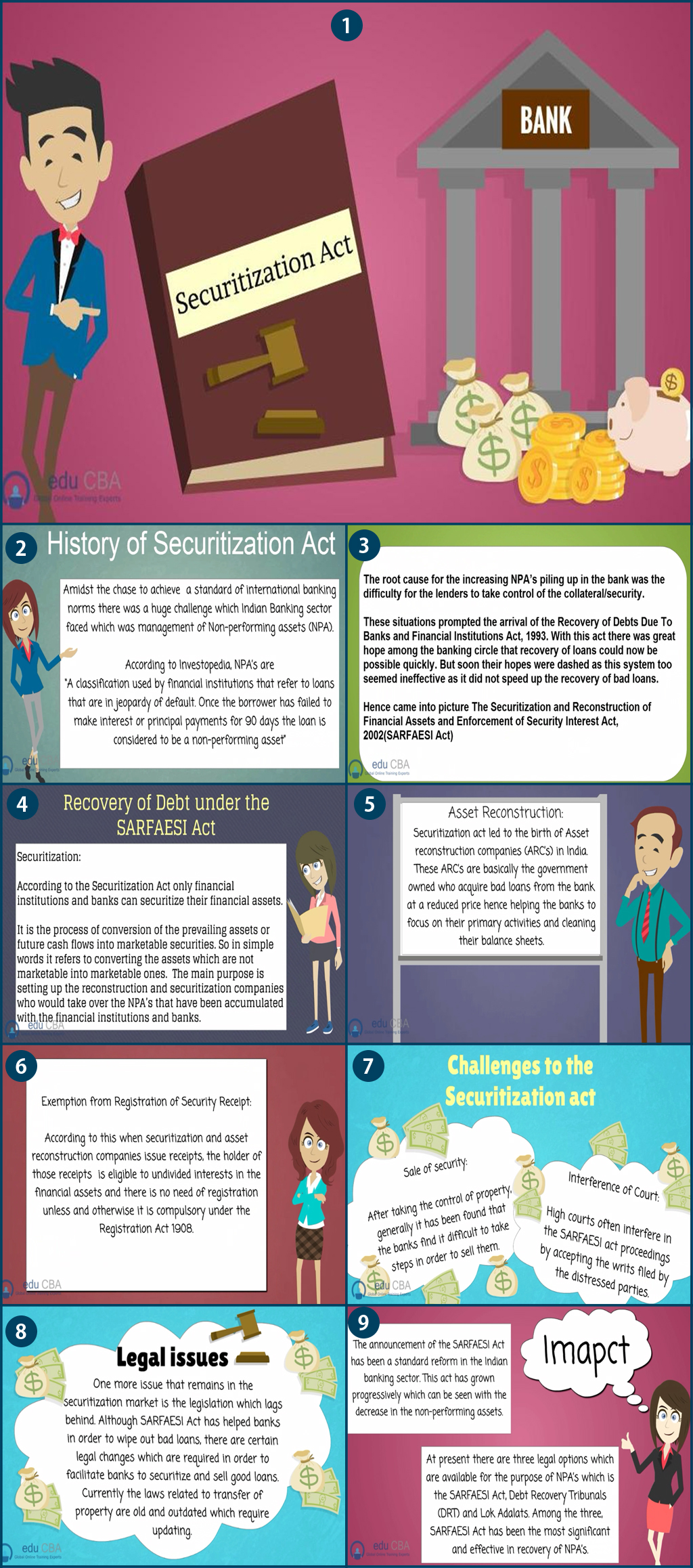
This article provides insight into the Securitization Act. We all know that the financial sector plays a very vital role in the progress of a nation. This sector has been one of the keys to gaining success in the rapid development of the economy. The banking sector strives to reach a level like international banking norms and standards. Amidst the chase to achieve that, there was a huge challenge that the Indian banking sector was facing, which was the management of Non-performing assets (NPA). Hearing this term for the first time?
According to Investopedia, Non-performing assets are,
“A classification used by financial institutions that refer to loans that are in jeopardy of default. Once the borrower has failed to make interest or principal payments for 90 days the loan is a non-performing asset”

They were critiqued for their helplessness to regulate and control their escalating bad debts. The root cause for the increasing NPAs piling up in the bank was the difficulty for the lenders to take control of the collateral/security. The creditors’ rights were very weak as the bankers could not effectively utilize the recovery procedures intended for bankrupt companies. These situations prompted the Recovery of Debts Due To Banks and Financial Institutions Act 1993. With this act, there was great hope among the banking circle that recovery of loans could now be possible quickly. But soon, their hopes were dashed as this system, too, seemed ineffective as it did not speed up the recovery of bad loans.
The situation so worsened that every fifth borrower was a default. This pressurized the government to undertake necessary provisions to recover the loan and foreclose the security (forcing the sale of the asset used as the collateral for the loan). Hence came into the picture: The Securitization and Reconstruction of Financial Assets and Enforcement of Security Interest Act, 2002 ( SARFAESI Act).
Before we learn about this act, let’s understand what securitization is. It is the conversion of the prevailing assets or future cash flows into marketable securities. So, in simple words, it refers to converting the assets that are not marketable into marketable ones. The main purpose is to set up the reconstruction and securitization companies that would take over the NPAs accumulated with the financial institutions and banks. Through this, it would be easy for the creditors to recover the dues from the defaulters in a much simpler and quicker way than before. The securitization acts would authorize the Financial Institutions and Banks to move ahead against borrowers with defaults in repayment and whose assets are secure. This article scans through the scope of the Securitization Act in relation to the recovery of dues, issues with the act, and its Impact on Banking
Recovery of Debt Under the Securitization Act
The Securitization Act makes provisions to recover the NPAs through the following methods:
1. Securitization
According to the Securitization Act, only financial institutions and banks can securitize their assets. Consider this example where GNB Bank gives out loans to customers known as the obligors. This will be on its balance sheet as assets, collecting principal and interest. The bank will hold on to these assets until maturity, so the bank’s funds are blocked in these loans. Banks would have to raise more funds from the market to meet the increasing fund requirement. Securitization is the method to unlock these blocked funds. It occurs by transferring the assets from the originator, GNB Bank in this case, to the Special purpose vehicle (SPV). You must be wondering what an SPV is and its role here.
An SPV is a distinct entity formed to facilitate securitization and provide funds to the originator. Also, another thing that needs to be considered is that the assets being transferred to the SPV need to be similar in terms of their maturity, risk profile, and underlying assets. The SPV will act as an intermediary that divides the originator’s assets into marketable securities. These securities are for the investors by the SPV as pass-through certificates (PTCs). The investors in such PTCs are banks, mutual funds, other financial institutions, the government, etc. In India specifically, only Qualified Institutional Buyers (QIBs) with the financial capacity and ability to take risks can invest in PTCs. Now, what does the SPV get in this transaction?
The difference between the interest payable by the obligor and the return to the investors is the service fee that the SPV earns. These securities are rated by credit rating agencies, which are used to inform the investor about the quality of the security and the risk involved. After the assets have been securitized, they are removed from the bank’s books, and the cash flows from the securitization can be used to give new loans. So, for GNB banks, securitization is an effective option for corporate debt or equity to meet their cash requirement.
2. Asset Reconstruction
The securitization act led to the birth of Asset reconstruction companies (ARCs) in India. These ARCs are government-owned and acquire bad loans from the bank at a reduced price, helping the banks focus on their primary activities and cleaning their balance sheets. The Act allows ARC to take ownership of the borrowers’ secured assets, including the right to transfer and realize the secured assets. They then sell the secured assets to other investors through PTCs.
3. Exemption from Registration of Security Receipt
According to this, when securitization and asset reconstruction companies issue receipts, the holder of those receipts is eligible for an undivided interest in the financial assets. There is no need for registration unless and otherwise. It is compulsory under the Registration Act 1908. However, the registration of the security receipt is necessary in the following cases:
- There is a transfer of receipt.
- The security receipt is creating, declaring, assigning, limiting, or extinguishing any right title or interest in an immovable property.
Learn the fundamental concepts of investment banking. Explore the concepts of financial modeling and valuation in detail. Exhibit skills to understand the process of M&A’s, IPOs, and Equity Research.
Prominent Features of the Securitization Act
Below are the features of the Securitization Act:
Incorporation & Registration of Special Purpose Vehicles
The Securitization Act intends to securitize and reconstruct financial assets through two special purpose vehicles (SPVs), the Securitization Company and the Reconstruction Company. Both companies must be incorporated under the Companies Act 1956 and have them as the main purpose. It is a requirement for the Securitization Company and the reconstruction company to register with the RBI before commencing their business operations.
Enforcement of Security Interest
The main aim of the Securitization Act is to make available the enforcement of security interest, which is to take possession of the assets that have been given as security for the loan. In the event of default by a borrower, this act authorizes the lender to issue a demand notice to both the borrower and guarantor to pay off the dues within 60 days from the date of the notice.
Even after the borrower fails to make the payment, the lender (Bank or financial institution) could resort to any of the following:
(i) Take ownership of the security;
(ii) Sale or lease or assign the right over the security;
(iii) Employ a Manager to manage the security;
(iv) Ask the borrower’s debtors to pay any sum due to the borrower.
In situations where there is more than one secured creditor, the provisions of this act will be valid only when 75% of them agree on the decision.
Impact of Securitization on Banking
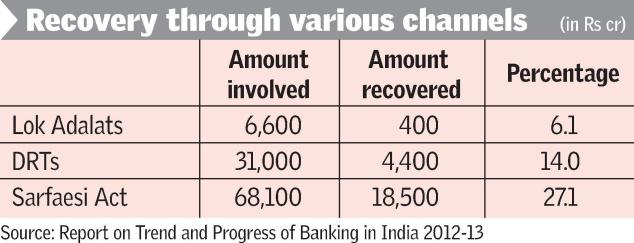
The announcement of the SARFAESI Act has been a standard reform in the Indian banking sector. This act has progressive growth, seen with the decrease in non-performing assets. Currently, three legal options are available for NPA: the SARFAESI Act, Debt Recovery Tribunals (DRT), and Lok Adalats. Among the three, the SARFAESI Act has been the most significant and effective in recovering NPA. According to the RBI’s Report on Trend and Progress of Banking in India, 2012-13, banks have recovered Rs 18,500 crore through the SARFAESI route. NPAs recovered through this Act accounted for about 80 percent of the total amount of NPAs.
Challenges to the Securitization Act
Below are the different challenges of the Securitization Act:
Sale of Security
After taking control of property, the banks generally find it difficult to take steps to sell them. Since there are no specific provisions to attain the property for its own, the bank can hold ownership without recourse to wipe off the liability from its books. With the court’s permission, the creditor can also participate in the auction and acquire the secured property. The securitization act fails to provide any specific provisions and rules.
Interference of Court
High courts often interfere in the SARFAESI Act proceedings by accepting the writs filed by the distressed parties. Although the decisions of the Supreme Court are effective only after the remedies in the respective statute exhaust, petitions are present in many matters. This often causes a lot of delays when it comes to the recovery of the loan.
Legal Issues
Another issue in the securitization market remains the legislation that lands. Legal changes are necessary to facilitate banks in securitizing and selling good loans despite the SARFAESI Act’s success in eliminating bad loans. Currently, the laws related to property transfer are old and outdated and require updating. The occurrence of stamp duty on the property, which varies across states, hampers the development of securitization. Also, the existing tax laws do not have any provision that has been made specifically only for securitization. Hence, new legislation would be necessary to resolve these issues.
Securitization has been a facilitator of asset recovery and reconstruction. There are various measures that the government undertook to confront the sickness among financial institutions and banks. With time, the situation in banks with respect to the menace of NPAs has improved. Blockage of capital in NPAs shrinks the capital adequacy ratio of the banks, and to improve this, they have to either raise more capital or free up the tied capital from their NPAs through securitization. Hence, with these supportive amendments, the Securitization Act’s scope will surely expand in future years.
Securitization Act Infographics
Learn the juice of this article in a single minute: Securitization Act Infographic.
Recommended Articles
Here are some articles that will help you get more details about the Securitization Act, so just go through the link.
- Investment Banking Culture
- Exchange-Traded Fund vs. Mutual Fund
- Investment Banking in India
- Investment Banking Career